

The law firm’s legal and tax experts provided comprehensive advice to Česká spořitelna in resolving a complicated tax issue related to a donation and its tax deductibility. The tax administration did not accept the reduction of the tax base in respect of a donation granted by Česká spořitelna to the Depositum Bonum Foundation. The tax administration argued that the foundation had not used all the donated funds in the tax period concerned. However, the decision of the tax administration was rejected by the Municipal Court in Prague and annulled for illegality.
The advice on the case was provided by a team specialising in tax proceedings and litigation led by partners David Krch, Josef Žaloudek and František Korbel and legal expert Alice Zemánková.
“This is a precedent-setting decision, as it confirms that the liability and the burden of proof to substantiate to the tax administration within what period the donor spent the funds for publicly beneficial purposes are not shifted to the donor,” David Krch explained.
After the Passbook Act was repealed, Česká spořitelna was left with funds of nearly CZK 2 billion, which were not collected by the beneficiaries after the cancellation of the passbooks despite repeated requests from Česká spořitelna. Therefore, Česká spořitelna established the Depositum Bonum Foundation, which supports educational projects, and donated the funds to it. Subsequently, Česká spořitelna deducted this donation from its tax base based on the provisions of the Income Taxes Act, which allows the tax base to be reduced by the value of donations made to public institutions or non-profit organisations and foundations that raise funds publicly for science, education, research and other publicly beneficial purposes.
However, the tax administration subsequently decided that the donation could not be deducted from the tax base. The administration argued, inter alia, that the donee, i.e. the foundation, was obliged to spend all the funds received in the year in which the donor claimed the tax base reduction. “However, the court accepted our reasoning that the donation for public benefit was made legally and in accordance with the conditions for reducing the tax base under the Income Taxes Act, even if the donation was not consumed in the year concerned,” says František Korbel, who represented Česká spořitelna in court as an attorney.
HAVEL & PARTNERS experts provided comprehensive legal advice to Ochranný svaz autorský (OSA), which administers the copyrights of Czech and foreign authors of audio and audio-visual recordings, in a dispute with the Office for Competition Protection (Office). The Office imposed a fine of CZK 10.7 million on OSA for alleged abuse of dominant position. The Regional Court in Brno concluded that the Office was not entitled to fine collective management societies in relation to determining royalty rates, since the Ministry of Culture acts as a competition authority of its own kind in these relations.
Since 2017, OSA has been represented in the litigation by HAVEL & PARTNERS’ team specialising in competition law, comprising partner Robert Neruda, partner Lenka Štiková Gachová and senior associate Vladislav Bernard. The Regional Court in Brno has now ruled in favour of the client and cancelled the multi-million fine.
“We welcome the court’s decision. From the start, we have maintained that we acted in full compliance with the then applicable wording of the Copyright Act, the common practice of collective management societies abroad, and in particular the rules for the protection of competition”, said Roman Strejček, Chairman of the OSA Board of Directors, regarding the court’s decision.
In 2020, the Office fined OSA for demanding payments from accommodation facilities for TV and radio receivers placed in rooms between 2008 and 2014 without taking into account the actual occupancy of the rooms.
OSA brought an action against the decision of the Office, challenging not only the illegality and unreviewability of the decision, but also the lack of subject-matter jurisdiction of the Office. Under the Copyright Act, it is the Ministry of Culture and not the Office that is responsible for supervising the activities of collective management societies, including the determination of royalty rates. The court upheld this argument and declared the decision null and void. According to the court, the decision of the Office suffered from such defects that it was not in fact an administrative decision at all.
The case is not only important for OSA but has implications for the entire sector of collective rights management. Its impact on practice has shown to the effect that shortly after its announcement, the court annulled a similar decision of the Office relating to the collective management organisation INTERGRAM, although INTERGRAM did not object to the nullity in its action at all. In doing so, it only acted in compliance with its official duty and relied on the reasoning applied by OSA earlier.
HAVEL & PARTNERS successfully represented in litigation the US company GoDaddy Inc., one of the largest global domain registration platforms. GoDaddy Inc. was sued by an influential businessman with connections to Russia, seeking the removal of investigative internet articles. He also demanded financial compensation.
The team of litigation experts, headed by partner Jan Šturm and senior associates Jan Králíček and Dalibor Slavík, argued in the Czech courts on behalf of GoDaddy Inc. that the client could not directly interfere with the content of the website and the articles posted there. This reasoning was also supported by an expert opinion on cybernetics and computer technology. The team also argued for freedom of speech and the importance of journalistic work in a democratic society. The courts eventually dismissed the lawsuit against GoDaddy Inc. in its entirety.
“This legal case was unique in terms of its technical complexity, as it was necessary to resolve and prove to the courts what entities were involved in the functioning of the Internet or specific websites, and who has the ability to interfere with the websites at all. The court’s decision in this case has the nature of a precedent because it defines the liability for content on the Internet of domain registrars and, by inference to some extent, also web hosting providers. We appreciate that the courts took a responsible and careful approach to this crucial issue and believe that the decision will contribute to the cultivation of the legal environment in the Czech Republic,” partner Jan Šturm explains. The GoDaddy Group currently has more than 21 million customers worldwide and administers over 84 million domain names. It employs approximately 7,000 employees.
Authors: František Neuwirth, Vlaďka Laštůvková
On 14 June 2023, the Czech government approved an amendment to the Act on Medicines, which imposes new obligations on marketing authorisation holders (“MAH”), distributors and pharmacies in order to ensure the availability of medicinal products on the Czech market. The proposal will now be debated in the Chamber of Deputies.
In order to achieve the above objective, the amendment proposes to introduce three sets of measures:
It is also proposed to abolish the current protected distribution system (known as “Lex Pawlas”), i.e. (in short) the obligation of the MAH to supply to a distributor who has made a written declaration to the MAH that it requires the medicinal product for patient care in the Czech Republic.
According to its current wording, the proposal should enter into force on the first day of the month following its publication in the Collection of Laws. Taking into account the standard length of the legislative process, it can be estimated that the proposal could enter into force on 1 November 2023 or 1 December 2023. However, it is proposed to postpone the applicability of certain obligations by several months (see below).
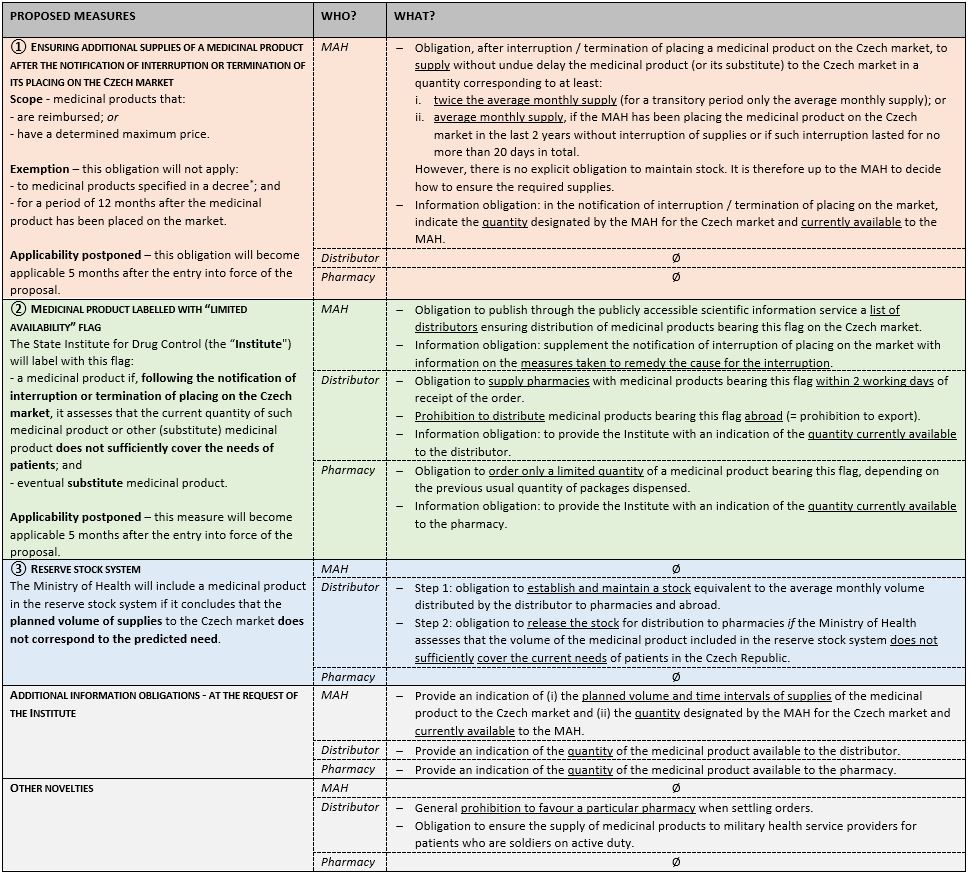
* No draft of this decree is available yet. According to a publicly available outline of this decree, the proposed exemption could apply, for example, to advanced therapy medicinal products, seasonal vaccines, short-expiring medicinal products, radionuclide generators and radionuclide precursors.
HOW IS THE PARLIAMENTARY DEBATE GOING TO CHANGE THE PROPOSAL?
The table above summarises the proposal as approved by the government. The approved wording differs from the original proposal of the Ministry of Health mainly in details and technicalities, despite the large number of comments made during the comment procedure. It remains to be seen whether and how the proposal will be amended during the parliamentary debate.